
Originally published October 11, 2016. Updated August 8, 2026.
Brushing cleans the outer, inner, and chewing surfaces of your teeth, but it cannot reach the spaces between them. Plaque left in those spaces hardens into tartar, irritates the gums, and leads to cavities and gum disease. Cleaning between your teeth once a day is one of the simplest habits for keeping your gums healthy. This guide explains how to floss correctly, what the research says about flossing, what alternatives work for braces or tight spaces, and how to get kids started.
Why should you clean between your teeth?
The American Dental Association (ADA) explains that interdental cleaning helps remove debris and plaque from between the teeth. When plaque hardens into tartar, it can only be removed by a professional, and gums around it may swell or bleed, a condition called gingivitis, the early stage of gum disease. See our guide to bleeding gums.
How do you floss correctly?
The ADA describes this step-by-step technique:
- Break off about 18 inches of floss. Wrap most of it around one of your middle fingers, and wind the rest around the same finger of the other hand.
- Hold the floss tightly between your thumbs and forefingers.
- Guide it between teeth with a gentle rubbing motion. Never snap the floss into your gums.
- Curve the floss into a C shape against one tooth when it reaches the gum line, and gently slide it into the space between the gum and the tooth.
- Rub gently up and down against the side of the tooth, then repeat on the neighboring tooth.
- Use a fresh section as you go, and remember the back surface of your last molars.
The ADA also says cleaning between your teeth should not cause pain. If it still hurts, talk with your dentist.
How often should you floss?
Once a day. The ADA recommends cleaning between teeth with floss or another interdental cleaner once a day, and says it does not matter whether you brush or floss first as long as the cleaning is thorough. Bedtime works well because it clears the day’s plaque before you sleep.
What does the research say about flossing?
The evidence is worth understanding. A 2019 Cochrane review of trials on home interdental cleaning found that floss or interdental brushes used in addition to toothbrushing may reduce gingivitis and plaque, and that interdental brushes may be more effective than floss. The reviewers also rated the certainty of the evidence as low to very low and noted that the effects may not be large. The ADA cites the same review. What this means in practice: cleaning between teeth helps, but it is one part of a routine that includes brushing twice a day with fluoride toothpaste and regular professional cleanings, and the best method is the one you will actually use every day. Read more in our guide to choosing toothpaste.
What are the alternatives to string floss?
The ADA recognizes several kinds of interdental cleaners, and the right one depends on your teeth. Floss may suit tight spaces, while interdental brushes suit people with gum disease or more open spaces. Options include:
- Interdental brushes, small brushes in various sizes.
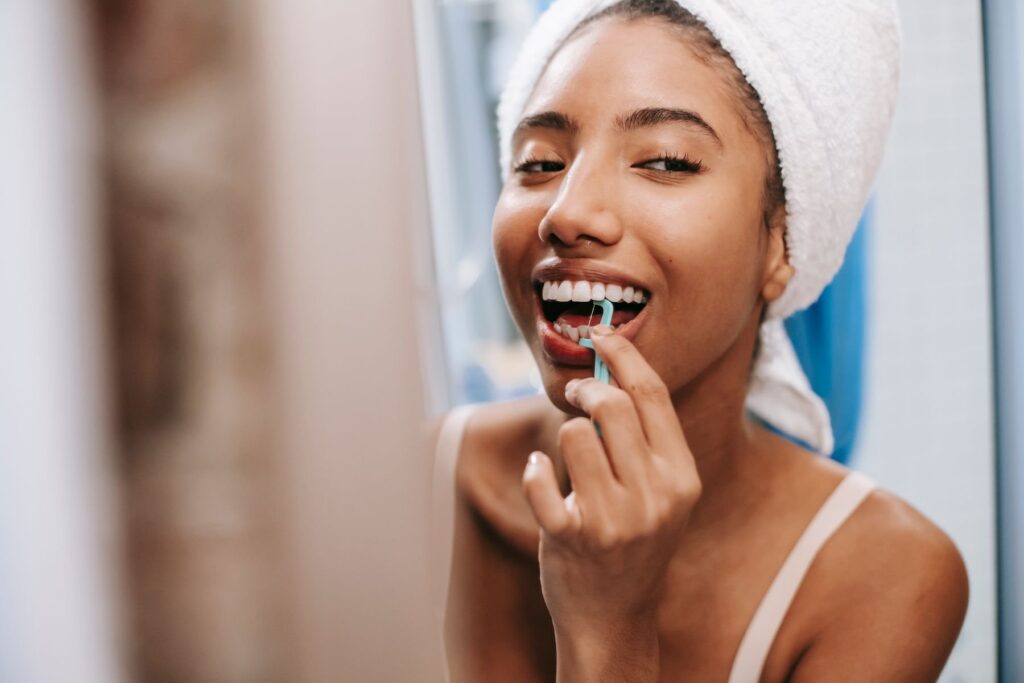
- Floss picks and sticks, convenient for one-handed use.
- Water flossers. The ADA says water flossers with the ADA Seal are safe and effective at removing plaque and can help reduce gingivitis, and that they are especially helpful for people with braces or fixed bridges.
If you wear braces or have a bridge or implants, ask us which tool suits you. See our guides to dental implants and preventing white spots with braces.
How do you teach children to floss?
The ADA advises starting daily interdental cleaning when a child has two teeth that touch, and parents typically do the flossing at first. As children gain dexterity, you can hand over the job with supervision. Floss picks and colorful flossers make it easier for small hands, and turning it into a routine, such as after brushing and before bed, helps it stick. Our pediatric dentistry team can show children how in a fun, low-pressure way.
Frequently asked questions about flossing
How often should you floss?
The American Dental Association recommends cleaning between your teeth once a day with floss or another interdental cleaner. Either brushing or flossing first is fine as long as you do a thorough job.
Is flossing really necessary?
Cleaning between teeth removes plaque and food where a toothbrush cannot reach, which is why the American Dental Association recommends it daily. A 2019 Cochrane review found that floss or interdental brushes added to toothbrushing may reduce gingivitis, although the certainty of the evidence was low and the effect sizes were small. Regular dental visits and good brushing remain essential.
Are water flossers as good as string floss?
Water flossers with the ADA Seal of Acceptance are safe and effective at removing plaque and can help reduce gingivitis. They are especially helpful for people with braces or fixed bridges. The American Dental Association does not present them as replacing conventional cleaning between teeth, but as an alternative when floss is hard to use.
Why do my gums bleed when I floss?
Bleeding usually means the gums are inflamed from plaque. It often improves within a couple of weeks of gentle daily cleaning. If it does not, or if flossing hurts, see your dentist.
When can children start flossing?
The American Dental Association recommends cleaning between your child's teeth daily once they have two teeth that touch. Parents usually need to do it for them at first.
Want a flossing tutorial?
Our hygienists are happy to show you the technique and recommend the best interdental cleaner for your teeth.
- Parham Road: 2314 E Parham Rd, Henrico, VA 23228, (804) 261-1970
- Brook Road: 9007 Brook Rd, Glen Allen, VA 23060, (804) 372-4420
First time with us? Visit our new patient page or contact us to get started.
Quick takeaways
- Cleaning between your teeth once a day removes plaque a toothbrush cannot reach.
- Use about 18 inches of floss, a gentle rubbing motion, and a C shape around each tooth. Never snap the floss.
- Research suggests interdental cleaning may reduce gingivitis, though the evidence is low certainty.
- Interdental brushes, floss picks, and ADA-accepted water flossers are good alternatives.
- Start children flossing when two teeth touch, with a parent’s help.
- If flossing hurts or gums keep bleeding, see your dentist.
Sources
- American Dental Association. Dental Floss/Interdental Cleaners. ADA Oral Health Topics.
- American Dental Association. Flossing. MouthHealthy.org.
- American Dental Association. Water Flossers and Water Flossing. MouthHealthy.org.
- Worthington HV, MacDonald L, Poklepovic Pericic T, et al. Home use of interdental cleaning devices, in addition to toothbrushing, for preventing and controlling periodontal diseases and dental caries. Cochrane Database of Systematic Reviews. 2019.
- American Dental Association. Healthy Habits: Babies and Kids. MouthHealthy.org.