

Originally published June 7, 2017. Updated August 24, 2026.
Losing a tooth affects more than your smile. It changes how you chew and speak, and over time the jawbone under the missing tooth can shrink and neighboring teeth can drift. A dental implant replaces the tooth root as well as the visible tooth, which is why it is one of the most durable solutions for tooth loss. It is also a surgical procedure that takes months, so it helps to understand the steps, the requirements, and the limits before you begin. This guide explains how implants work, who is a candidate, what the process involves, and how to care for them.
What is a dental implant?
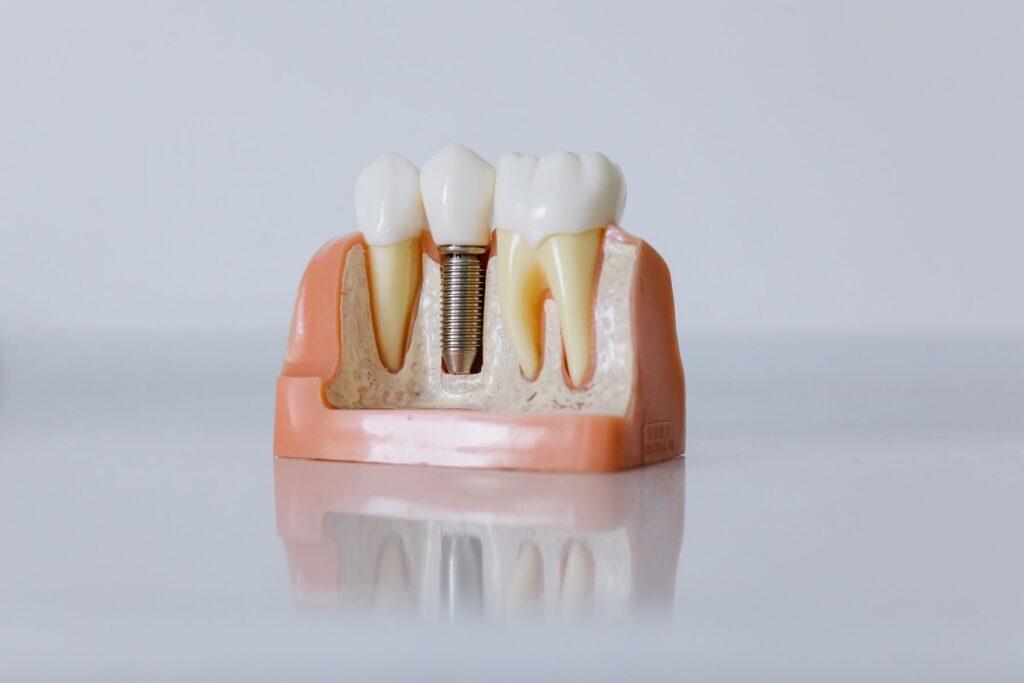
Cleveland Clinic describes dental implants as small, threaded posts that are surgically placed to replace missing teeth. An implant has three parts:
- The post, an artificial tooth root placed in the jawbone.
- The abutment, a connector that extends slightly above the gum.
- The restoration, the visible artificial tooth, which may be a crown, a bridge, or a denture.
Once healed, an implant functions much like a natural tooth. Our dental implants page has more about how we approach treatment.
Who is a good candidate for dental implants?
Cleveland Clinic says candidates should be fully grown, at least 18, with enough healthy jawbone, and that there is no upper age limit. Factors that make someone a poorer candidate include active gum disease, severe bone loss, unmanaged diabetes, poor oral hygiene, smoking or vaping, and certain autoimmune conditions. Many of these can be addressed first. If you have gum disease, our periodontal care can treat it, and see our post on bleeding gums to understand the early warning signs.
What does the implant process involve?
- Evaluation and planning. Your dentist examines your mouth and jawbone, usually with imaging, and plans placement.
- Surgery. After anesthesia, the gum is opened to expose the bone, the bone is prepared, the implant is placed, and the gum is closed.
- Healing. The jawbone fuses to the implant in a process called osseointegration, which Cleveland Clinic says takes three to nine months.
- Restoration. Once healed, the abutment and the crown, bridge, or denture are attached.
How long do dental implants last, and how often do they fail?
Cleveland Clinic says that with proper care, an implant can last a lifetime, while the restoration on top typically needs replacement, roughly every 15 years for crowns and bridges. Success rates are high but not perfect, and they depend on who places the implant and how well it is maintained. A retrospective study in the Journal of the American Dental Association of implants placed in general dental practices found that 7.0 percent were classified as failures over an average of 4.2 years, and a higher share when bone loss was counted, suggesting that outcomes in general practice may be lower than those reported in specialty settings. A systematic review in the same journal concluded that implant survival rates do not exceed those of compromised but adequately treated and maintained natural teeth. In practical terms, the better choice is often to keep a natural tooth when it can be saved, for example with a root canal, and to choose an experienced provider when an implant is needed.
How do you care for dental implants?
Implants cannot decay, but the gum and bone around them can become infected. The American Academy of Periodontology describes two conditions. Peri-implant mucositis is gum inflammation around the implant without bone loss, and it may be reversible if caught early. Peri-implantitis involves deterioration of the bone supporting the implant and usually requires surgical treatment. Risk factors include poor oral hygiene, smoking, uncontrolled diabetes, and alcohol use, and the warning signs, red or tender gums or bleeding when brushing, resemble those of gum disease. To protect an implant:
- Brush twice a day and clean around the implant daily. See how to floss correctly.
- Keep regular cleanings and exams so your dentist can check the implant and the bone around it.
- Avoid tobacco and keep diabetes well controlled.
- Call your dentist if an implant feels loose or your gums bleed, swell, or produce pus.
What are the alternatives to dental implants?
Cleveland Clinic lists traditional dentures and dental bridges as alternatives. A bridge relies on the neighboring teeth, which must be shaved down to support it. Dentures are removable and can be a good option depending on your health and budget. Implants can also anchor dentures for a more secure fit. We can talk through which option best fits your needs and health.
Frequently asked questions about dental implants
What is a dental implant?
A dental implant is a small threaded post, usually titanium, that is placed in the jawbone to replace a missing tooth root. An abutment connects it to a restoration, such as a crown, bridge, or denture, that looks and functions like a natural tooth.
How long does the dental implant process take?
Healing is the longest part. Cleveland Clinic says the jawbone fuses to the implant in a process called osseointegration, which takes three to nine months, after which the abutment and restoration are attached.
How long do dental implants last?
With proper care, the implant itself can last a lifetime, according to Cleveland Clinic. The crown, bridge, or denture attached to it usually needs replacing sooner, on the order of 15 years for crowns and bridges.
Who is not a good candidate for implants?
Cleveland Clinic lists active gum disease, severe bone loss, unmanaged diabetes, poor oral hygiene, and smoking or vaping as factors that make someone a poorer candidate. Some can become candidates after these are treated.
Can dental implants fail?
Yes. Outcomes vary. A study of implants placed in general dental practices found 7 percent were classified as failures at an average of 4.2 years. Good oral hygiene, avoiding tobacco, and regular checkups help protect implants from infection and bone loss around them.
Missing a tooth? Explore your options
Book an implant consultation and we will review your bone and gum health, your goals, and the best replacement options.
- Parham Road: 2314 E Parham Rd, Henrico, VA 23228, (804) 261-1970
- Brook Road: 9007 Brook Rd, Glen Allen, VA 23060, (804) 372-4420
First time with us? Visit our new patient page or contact us to get started.
Quick takeaways
- An implant replaces the tooth root with a post, then adds an abutment and a crown, bridge, or denture.
- Good candidates have enough healthy bone and healthy gums. Smoking, active gum disease, and unmanaged diabetes raise the risk.
- Healing takes three to nine months, so plan for a process rather than a single visit.
- The implant can last a lifetime with care. The restoration on top usually needs replacing sooner.
- Implants can fail, so choose an experienced provider and keep up with hygiene and checkups.
- Bridges and dentures are alternatives, and saving a natural tooth is often best when possible.
Sources
- Cleveland Clinic. Dental Implants: Permanent, Lifelike Tooth Replacements.
- American Academy of Periodontology. Peri-Implant Diseases.
- Da Silva JD, Kazimiroff J, Papas A, et al. Outcomes of implants and restorations placed in general dental practices: a retrospective study by the PEARL Network. Journal of the American Dental Association. 2014.
- Levin L, Halperin-Sternfeld M. Tooth preservation or implant placement: a systematic review of long-term tooth and implant survival rates. Journal of the American Dental Association. 2013.