
Originally published July 14, 2017. Updated August 14, 2026.
Dental X-rays let your dentist see what a visual exam cannot: cavities between teeth, infection at the root, bone loss from gum disease, and teeth that have not yet come in. They are one of the most useful diagnostic tools in dentistry, and they use very low doses of radiation. Still, it is reasonable to ask why they are needed and how often. Current professional guidance is that X-rays should be taken only when they will help your dentist make a decision about your care. This guide explains what dental X-rays show, the common types, how safe they are, and how often you need them.
Why do dentists take X-rays?
According to the American Dental Association (ADA), X-rays help dentists confirm that your teeth are healthy or reveal damage or disease not visible during a dental exam, such as new cavities or impacted teeth. Many problems start out of sight, between teeth, under fillings, below the gum line, or inside the bone, and are easier and cheaper to treat when found early. X-rays can also reveal infections at the root, cysts, and the position of wisdom teeth, and they help plan treatments such as implants, root canals, and orthodontics.
What are the common types of dental X-rays?
- Bitewing X-rays show the crowns of the upper and lower back teeth together and are especially good at finding cavities between teeth.
- Periapical X-rays show an entire tooth from crown to root tip and the surrounding bone, which helps diagnose infection or root problems.
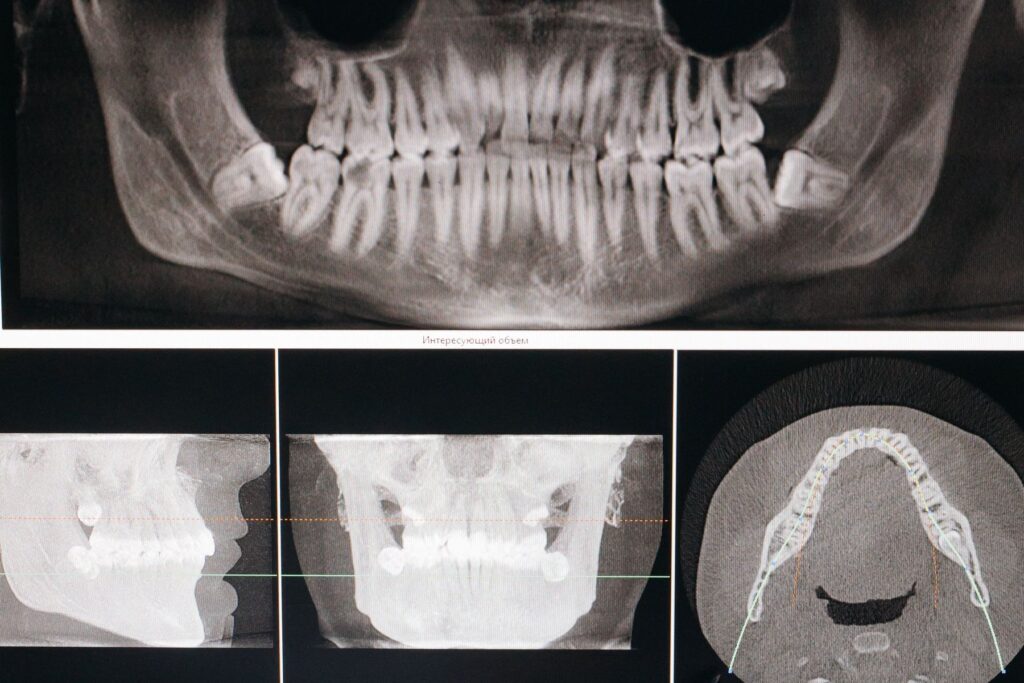
- Panoramic X-rays capture the entire upper and lower jaws in one image, useful for assessing wisdom teeth, jaw problems, and overall development.
- 3D cone beam imaging (CBCT) produces three-dimensional views for complex cases such as implant planning.
We use digital X-rays and, when a case calls for it, 3D imaging, which are part of the technology we use for diagnosis.
How often do you need dental X-rays?
There is no single schedule that fits everyone. The ADA says frequency depends on your present oral health, age, risk for disease, and signs or symptoms. The ADA and FDA jointly publish guidance for dentists on selecting patients for X-rays. It advises ordering radiographs only when the additional information is expected to affect patient care, after reviewing your medical and dental history, past images, and a clinical exam. According to that guidance, bitewings are the only imaging with a suggested frequency, and decisions to repeat panoramic or full-mouth X-rays should rest on your individual needs rather than on what an insurance contract allows. A child with a high cavity risk may need bitewings more often than an adult with a healthy mouth and no history of decay.
Are dental X-rays safe?
The ADA states that dental X-rays emit very low doses of radiation and that doses in dental imaging are much lower now than in the past because of technological advances. Dentists follow the ALARA principle, keeping exposure as low as reasonably achievable, and use X-rays in moderation. A 2024 expert panel convened by the ADA also concluded that abdominal and thyroid shielding is no longer recommended for dental imaging, because shields can block the main beam and lead to additional X-rays. If you have concerns, ask your dentist why a particular X-ray is being taken.
Are dental X-rays safe during pregnancy?
Yes. The ADA and the American College of Obstetricians and Gynecologists both say dental X-rays are safe at any stage of pregnancy when needed. Let your dentist know you are pregnant so they can plan accordingly. Read our guide to pregnancy and oral health.
What are the benefits of catching problems early?
Small cavities found on an X-ray can often be treated with a simple filling, while the same cavity found late might need a root canal or crown. X-rays also help us monitor bone levels around teeth if you have gum disease, so see our periodontal care. Regular exams with the right imaging are part of our preventive dentistry, and they are why we recommend keeping up with checkups. See how often to visit the dentist.
Frequently asked questions about dental X-rays
Why do dentists take X-rays?
X-rays let dentists confirm that your teeth are healthy or reveal damage or disease that cannot be seen during an exam, such as new cavities, infections, or impacted teeth. The American Dental Association says they should be taken only when your dentist believes they will provide necessary diagnostic information.
How often do I need dental X-rays?
It depends on you. The American Dental Association says frequency varies with your current oral health, age, risk for disease, and any signs or symptoms. Only bitewings have a suggested frequency in the FDA and ADA selection guidance, and repeat panoramic or full-mouth X-rays should be based on your individual needs, not on insurance limits.
Are dental X-rays safe?
Dental X-rays use very low doses of radiation, and the American Dental Association notes that doses are much lower than they used to be because of advances in technology such as digital sensors. Dentists follow the principle of keeping exposure as low as reasonably achievable.
Are dental X-rays safe during pregnancy?
Yes, when needed. The American Dental Association and the American College of Obstetricians and Gynecologists both state that dental X-rays are safe at any point during pregnancy. Tell your dentist you are pregnant.
Do I still need a lead apron or thyroid collar?
Not necessarily. The American Dental Association now says abdominal and thyroid shielding is no longer needed for patients of any age or health status, because shields can block the main beam and lead to retakes. Your dentist will follow current recommendations.
Questions about X-rays at your next visit?
We are happy to explain why each image is recommended and how we keep exposure low.
- Parham Road: 2314 E Parham Rd, Henrico, VA 23228, (804) 261-1970
- Brook Road: 9007 Brook Rd, Glen Allen, VA 23060, (804) 372-4420
First time with us? Visit our new patient page or contact us to get started.
Quick takeaways
- Dental X-rays reveal cavities, infection, and bone loss that cannot be seen during a visual exam.
- Common types include bitewing, periapical, panoramic, and 3D cone beam images.
- X-rays should be taken only when they will help make a care decision, and frequency depends on your individual needs.
- Doses are very low and much lower than in the past. Thyroid and abdominal shields are no longer recommended.
- X-rays are safe during pregnancy when needed.
- Finding problems early usually means simpler, less costly treatment.
Sources
- American Dental Association. X-Rays. MouthHealthy.org.
- U.S. Food and Drug Administration and American Dental Association. ADA/FDA Guide to Patient Selection for Dental Radiographs.
- American Dental Association. X-Rays/Radiographs. ADA Oral Health Topics.
- American Dental Association. Pregnancy. ADA Oral Health Topics.